

As an Amazon Associate, I earn from qualifying purchases. This post may contain affiliate links.
Worksheets are everywhere in early math. They’re easy to print, simple to assign, and give the reassuring feeling that learning is happening.
But here’s the problem: for young children, worksheets often create the appearance of learning without building real understanding.
Many parents don’t realize this until later—when their child can complete worksheets but struggles with simple questions like “Which has more?” or “What happens if we add one more?”
If you want a stronger starting point, read How to Teach Counting the Right Way.
In Short
- Worksheets focus on symbols before understanding
- They reduce hands-on, sensory learning
- They encourage passive thinking instead of problem-solving
- They do not build strong number sense
Why Worksheets Feel Effective (But Often Aren’t)
Worksheets create a sense of progress because:
- Pages get completed
- Answers look correct
- Skills appear measurable
However, young children are still developing the ability to think abstractly. Numbers on a page are symbols—and without hands-on experience, those symbols have little meaning.
According to the National Research Council in Adding It Up: Helping Children Learn Mathematics, early math success depends on conceptual understanding—not just correct answers. Worksheets tend to emphasize answers over understanding.
1. Worksheets Teach Symbols Before Meaning
Most worksheets ask children to trace, circle, or match numbers. These tasks can improve recognition, but they often bypass understanding.
A child might correctly identify the number 5—but still not understand that it represents a quantity that can be built, compared, or broken apart.
When a child works with a Melissa & Doug Wooden Number Puzzle, they physically place each piece and connect the symbol “5” to a real quantity. That moment of connection is what worksheets often miss.
For a deeper approach, see How to Teach Number Recognition (Without Worksheets).
2. Worksheets Remove Hands-On Learning
Early math is meant to be experienced physically. Children need to:
- Hold objects
- Move them
- Combine and separate groups
- See changes happen
When a child uses Learning Resources Counting Bears with Bowls, they can actively explore what happens when numbers change. They can make mistakes, adjust, and try again—something a worksheet cannot replicate.
Research from the National Association for the Education of Young Children shows that hands-on, play-based learning leads to deeper and more lasting understanding in early childhood.
3. Worksheets Encourage Passive Thinking
Worksheets train children to follow directions and look for correct answers. But math is not about compliance—it’s about thinking.
Strong math learners:
- Ask questions
- Test ideas
- Notice patterns
- Make connections
When using Learning Resources Numberblocks MathLink Cubes, a child can discover relationships like 4 + 3 = 7 through exploration. That kind of learning builds understanding that sticks.
To support this kind of thinking, explore The Best Hands-On Math Activities for Early Learners.
4. Worksheets Prioritize Rote Skills Over Number Sense
Counting and number recognition are important—but they are only the beginning.
True number sense includes:
- Understanding quantity
- Comparing amounts
- Seeing relationships between numbers
- Breaking numbers apart and recombining them
A child working with a Montessori Number Rods Set can visually see that 8 is longer than 5, building an intuitive sense of magnitude that worksheets cannot provide.
For more strategies, read Number Sense Activities That Actually Work.
5. Worksheets Can Lead to Frustration
Worksheets often require skills that are still developing:
- Fine motor control
- Visual tracking
- Following written instructions
When children struggle with these, math can quickly become frustrating.
This can lead to:
- Avoidance
- Reduced confidence
- Negative attitudes toward learning
Hands-on learning removes these barriers and allows children to focus on understanding.
A Common Mistake Parents Make
When children struggle with math, it’s natural to assume they need more practice.
But adding more worksheets often makes the problem worse.
If a child doesn’t fully understand a concept, repeating the same type of task reinforces confusion rather than fixing it. The solution is not more repetition—it’s better, more meaningful experiences.
What to Do Instead (The Better Approach)
The most effective early math learning happens through hands-on, real-world experiences.
Use Real-Life Math Every Day
Math can be naturally integrated into daily routines:
- “Can you bring me 3 spoons?”
- “Which pile has more?”
- “What happens if we add one more?”
These small moments build deep understanding over time.
Explore:
Choose Tools That Encourage Exploration
The right materials can guide learning without limiting it:
- With Learning Resources Counting Bears with Bowls, children can physically sort, compare, and combine groups—helping them understand how numbers work rather than just memorize them.
- Learning Resources Numberblocks MathLink Cubes support building and breaking apart numbers
- Melissa & Doug Wooden Number Puzzle strengthens number-to-quantity connections
These tools promote thinking—not just answering.
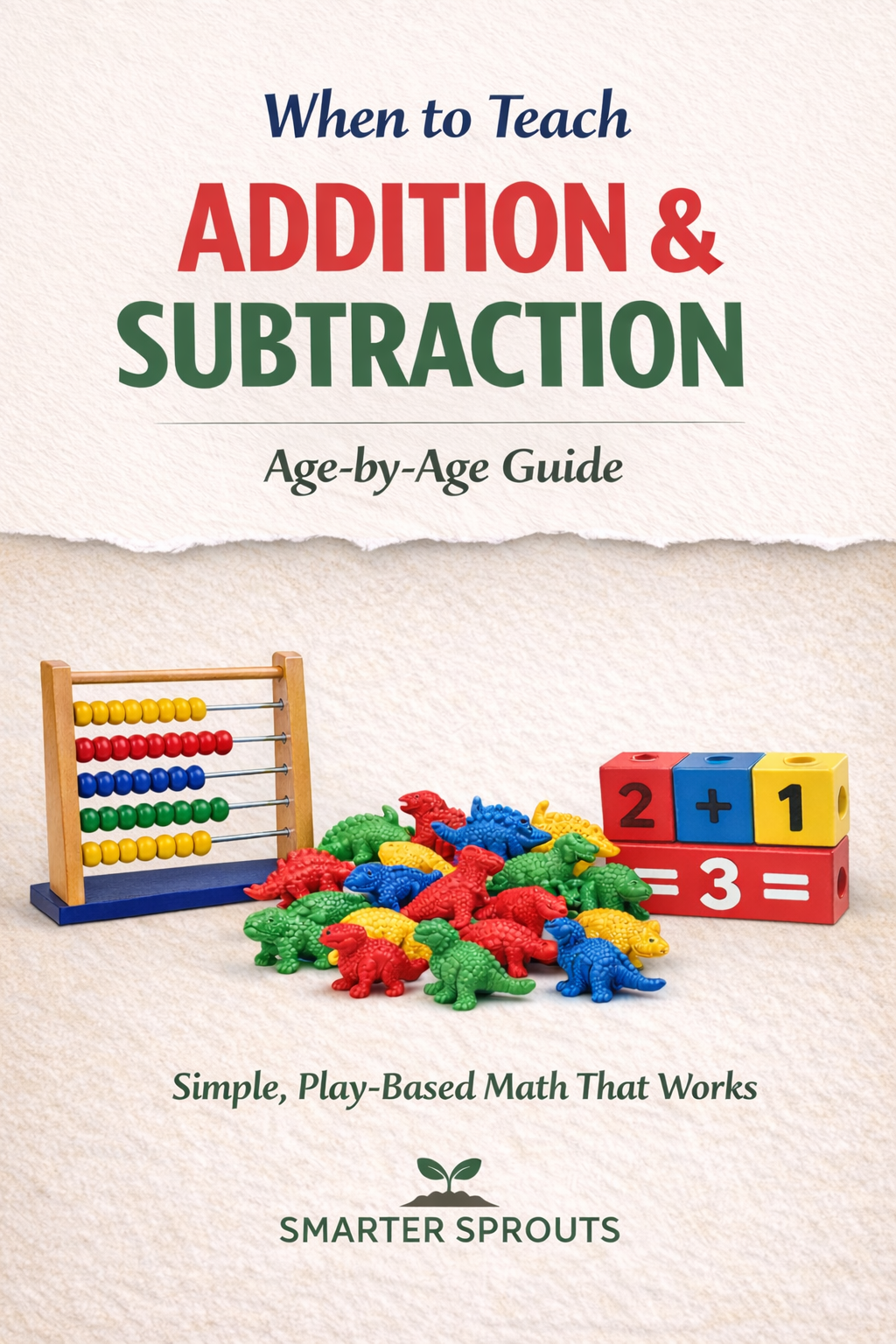
Introduce Addition and Subtraction Through Play
Before worksheets, children should experience math in action:
- Combine groups of objects
- Remove items and observe changes
- Compare before and after
Learn how:
Frequently Asked Questions
Are worksheets bad for preschoolers?
Not inherently. The issue is timing and overuse. Worksheets are often introduced before children have the foundational understanding needed to benefit from them.
What is better than worksheets for early math?
Hands-on learning, play-based activities, and real-life experiences are significantly more effective for building number sense.
When should worksheets be introduced?
Worksheets are most useful after a child understands a concept. At that point, they can reinforce learning—but should not be the primary teaching method.
The Bottom Line
Worksheets may look productive, but they often prioritize correct answers over real understanding.
Children learn math best when they can:
- Touch
- Move
- Explore
- Experiment
When you shift away from worksheets and toward hands-on learning, you’re not just improving math skills—you’re building a child who understands numbers deeply, solves problems confidently, and approaches learning with curiosity instead of frustration.
For a complete framework, visit Parent Guides for Teaching Math and Number Skills at Home.
Final Takeaway
If your goal is long-term success in math, the approach matters.
Less paper. More experience.
Because understanding—not repetition—is what truly builds strong math learners.